
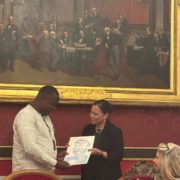
 The Henry Dunant Field Prize 2025 has been awarded to Mr. Zakaria Daboné, Burkinabe jurist, teacher, researcher and practitioner of international humanitarian law, whose career combines with rare coherence commitment in the field, academic rigor and fidelity to the spirit of Henry Dunant.
The award ceremony was held on 20 November 2025, in the Alabama Room of the Geneva City Hall, a highly symbolic place in humanitarian history and the peaceful resolution of conflicts. It was in this context that the laudatio was pronounced, retracing an intellectual and human journey deeply rooted in the contemporary realities of armed conflicts.
Read the laudatio (speech) by Roger Durand, as well as Zakaria’s speech (automated translations).
A man of the field at the service of the law
Based in Burkina Faso, Zakaria Daboné teaches international humanitarian law at the Nazi Boni University in Bobo-Dioulasso. He has held central positions in the implementation of international humanitarian law and human rights, in particular as Permanent Secretary of the National Commission on IHL and Human Rights.
His commitment goes far beyond the national framework. As a member of the African Union Mission for the Central African Republic and Central Africa, he took part in the negotiations that led to the Agreement for Peace and Reconciliation in the Central African Republic, signed on 6 February 2019. In this context, it has made a decisive contribution to raising awareness among armed groups, particularly on the norms of international humanitarian law, which is an essential condition for any credible negotiation.
At the same time, Zakaria Daboné has trained, in Burkina Faso and in many African states, soldiers, magistrates, lawyers, diplomats, parliamentarians, civil servants and civil society actors, thus contributing to the concrete rooting of humanitarian law in institutional practices.
An academic trajectory of excellence
A man of the field, Zakaria Daboné is also a recognized academician. Trained in Geneva, he was a student, a doctoral student, and then a teaching and research assistant at what is now the Academy of International Humanitarian Law and Human Rights in Geneva. He distinguished himself by the excellence of his results, obtaining in particular the best mark in his class in special education under Professor Marco Sassòli.
His doctoral thesis, defended in January 2011 at the University of Geneva and entitled Le droit international public relatif aux groupes armés non-états, was awarded the “very good” distinction, the highest distinction awarded at the time. Published as the first volume of the Geneva Collection of International Law, it remains a reference on a subject at the heart of contemporary challenges in humanitarian law.
His recent work focuses in particular on the asymmetrical application of international humanitarian law in non-international armed conflicts, as well as on the conditions for differentiated application by non-State armed groups. This research, which is both theoretically demanding and empirically anchored, testifies to a constant desire to make the law relevant to the realities on the ground.
Choosing Return and Engagement
After a post-doctoral fellowship at the University of Michigan, Zakaria Daboné made the demanding and profoundly Dunantian choice to return to his country. He continued his commitment to the service of the institutions, in particular as a member of the National Drafting Committee of the Practical Guide to the Conclusion of International Treaties and Agreements of Burkina Faso.
In recognition of his academic contribution, the Burkinabe State recently elevated him to the rank of Knight of the Order of Academic Palms, on the occasion of the 65th anniversary of national independence.
Free and lucid speech
In his laureate speech, delivered during the ceremony, Zakaria Daboné delivered a demanding reflection on the strengths and weaknesses of Geneva in the implementation and development of international humanitarian law. In it, he expresses lucid concern about the loss of momentum of IHL, highlighting the contradictions of a legal order shaped by States even though many of them are now parties to armed conflicts.
Above all, he reminds us that international humanitarian law is neither a dogma nor a sacred text, but a human construction, called upon to evolve in order to remain faithful to its primary purpose: to alleviate the suffering of war, without ever resigning itself to it.
Fidelity to the spirit of Henry Dunant
Like Henry Dunant, Zakaria Daboné idealizes neither war nor armed actors. But, like him, he understood that the humanization of conflicts requires rules that are realistic, intelligible and appropriate by those to whom they are addressed. His career, marked by a constant back and forth between reflection and action, strongly embodies the spirit of the Henry Dunant Terrain Prize.
By awarding him the 2025 Prize, the Foundation salutes an already considerable body of work and expresses the hope that this commitment can continue, despite a particularly trying international and regional context.